


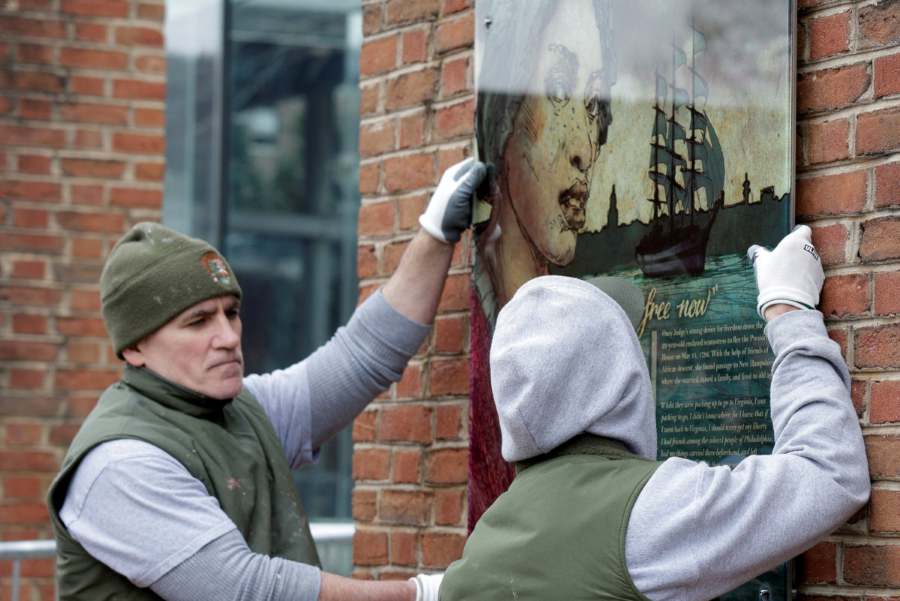
A long-running legal dispute between the city of Philadelphia and the Trump administration came to a head this week with the restoration of an important exhibit on the history of slavery at the President’s House site on Independence Mall. The exhibit, detailing the lives of the nine enslaved individuals who lived and worked for President George Washington, was removed by the federal government in January 2026, sparking a legal battle that culminated in a federal judge’s ruling.
The exhibit’s return is being hailed as a victory for historical accuracy and transparency. Mayor Cherelle L. Parker, who played a central role in the fight to restore the exhibit, visited the site on Thursday to thank the National Park Service workers tasked with reinstalling the panels. “Today we celebrate the return of our history at this important site,” Parker said. “We know this victory isn’t the end of the legal road, but we will continue to challenge any efforts to erase our history.”
The exhibition had been part of a city-federal collaboration that began in 2006 and highlighted the enslaved people who served Washington at his Philadelphia residence. The materials were abruptly removed in late January, just before the start of Black History Month, after the Trump administration issued an executive order aiming to revise how slavery and racism are portrayed at U.S. landmarks.
Legal and Political Controversy
The removal of the exhibit set off a wave of public outcry, prompting the city to file a lawsuit against the Department of the Interior, which oversees the National Park Service. The lawsuit argued that the federal government had no right to unilaterally remove or alter the materials without the city’s consent, given their joint role in curating and managing the site. U.S. District Judge Cynthia Rufe sided with the city, ruling that the removal violated the First Amendment and comparing the actions of the Trump administration to a “Ministry of Truth” from George Orwell’s 1984.
Judge Rufe’s decision highlighted the danger of allowing the government to rewrite historical narratives, particularly one as significant as slavery. She emphasized the court’s duty to protect historical truths, stating, “The federal government does not have the power to disassemble and disassemble historical truths when it has domain over historical facts.”
The Trump Administration’s Stance
In defense of its actions, the Trump administration argued that the National Park Service routinely updates exhibits for accuracy and completeness. The administration claimed that it planned to replace the removed materials with updated exhibits that would include more comprehensive information about the history of slavery, including the stories of the nine enslaved individuals who lived in the President’s House.
However, the city and various historical advocates saw this as an attempt to sanitize American history and rewrite uncomfortable truths. The Trump administration’s broader stance on historical interpretation has been controversial, with the government pushing to downplay discussions of systemic racism and historical oppression at museums and public sites.
Despite the win, the fight is far from over. The Trump administration has already filed an appeal of the ruling, arguing that the federal government has sole authority to dictate which historical narratives are presented at national parks. As this legal battle continues, the exhibit’s return serves as a reminder of the enduring power of public advocacy and legal action in preserving historical integrity.
The restoration of the slavery exhibit is significant not only for its detailed portrayal of the individuals enslaved by Washington but also for its role in the ongoing conversation about race and history in America. The exhibit’s panels tell the stories of figures such as Oney Judge, who escaped from Washington’s household, and Richmond, a man who was forced to stay behind when the Washingtons moved out of Philadelphia.
As Independence Mall gears up for increased visitation during the nation’s 250th anniversary in 2026, the restored exhibit will stand as a vital part of Philadelphia’s historical landscape, ensuring that the stories of these enslaved individuals are not forgotten.
