


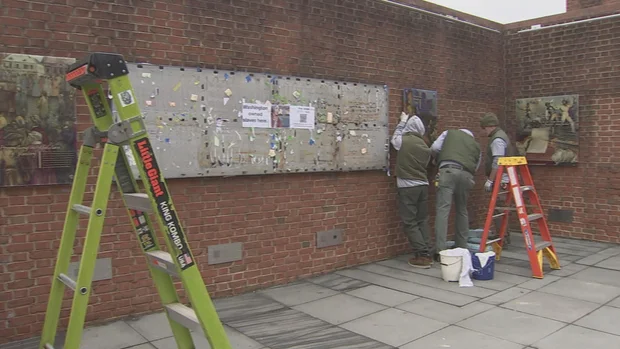
In a significant legal ruling, U.S. District Judge Cynthia Rufe has set a deadline for the Trump administration to restore an important slavery exhibit at the President’s House site in Philadelphia, a historical location where George Washington once resided. The exhibit, which memorializes the lives of enslaved individuals who served Washington during his time in the nation’s temporary capital, was abruptly removed by the National Park Service (NPS) in January 2026. Judge Rufe’s decision, issued on President’s Day, directs that the materials be fully reinstated by Friday, February 20, despite ongoing appeals from the federal government.
The exhibit’s removal sparked widespread outcry from local leaders, historians, and activists, with the city of Philadelphia filing a lawsuit against the U.S. Department of the Interior and the National Park Service. The city contended that the removal violated a longstanding agreement between Philadelphia and the federal government regarding the stewardship of the President’s House, a landmark site within the city’s Independence Mall. Judge Rufe agreed, granting the city’s request for a preliminary injunction, which mandates that the exhibit be restored immediately.
The materials, which had been on display since 2010, detail the lives of nine enslaved individuals who lived at the President’s House during Washington’s two terms in office. The exhibit, created through a partnership between the city, historians, and the NPS, was part of an effort to provide a more complete picture of American history—one that includes the difficult and painful realities of slavery.
Controversy Over Historical Narrative
The removal of the exhibit was part of a broader push by the Trump administration to revise how history is presented at national parks and museums. The administration cited an executive order signed by President Donald Trump in 2025, which instructed the Department of the Interior to ensure that public historical displays focus on “the greatness of the achievements and progress of the American people,” rather than “inappropriately disparaging” aspects of the nation’s past. This move was widely criticized by historians and advocates, who viewed it as an attempt to erase or whitewash critical moments in U.S. history.
Judge Rufe sharply rebuked the federal government’s actions, invoking the dystopian novel “1984” by George Orwell, which describes a totalitarian regime that manipulates historical records. Rufe wrote in her opinion, “As if the Ministry of Truth in George Orwell’s 1984 now existed, with its motto ‘Ignorance is Strength,’ this Court is now asked to determine whether the federal government has the power it claims—to dissemble and disassemble historical truths.” She further stated that the federal government “does not have the authority to rewrite history” in this way.
Legal and Public Reactions
The ruling has been welcomed by local leaders and activists. Philadelphia Mayor Cherelle L. Parker, who has been vocal in her opposition to the removal of the exhibit, expressed her gratitude for the court’s decision, calling it a victory for historical integrity. She acknowledged the tireless efforts of community advocates and historians who have fought to ensure that the full story of America’s past is told. “This is a victory not just for Philadelphia, but for the nation,” Parker said in a statement. “We will continue to ensure that these truths are not erased.”
The case is far from over, as the Trump administration has signaled its intent to appeal the ruling, further prolonging the legal battle. The federal government has argued that the NPS should be allowed to update and reinterpret historical materials without local interference, but the court’s decision underscores the importance of preserving an accurate, unaltered account of history.
Cultural and Historical Significance
The President’s House was the residence of George Washington and his successor, John Adams, during the late 18th century. While Washington lived in the house, he enslaved several people, and the exhibit at Independence Mall is one of the few public displays that acknowledge their lives and contributions to the founding of the nation. Figures such as Oney Judge, who escaped from Washington’s household, and Richmond, who was forced to stay behind when Washington moved out of Philadelphia, are featured in the exhibit.
As the 250th anniversary of the United States approaches, with Philadelphia set to be a focal point of the celebrations, the restored exhibit will be an essential part of the city’s historical narrative. It will provide future generations with a more complete understanding of the complexities of America’s founding, including the lives of those who were forcibly subjugated in its early years.
The fight for the restoration of the President’s House exhibit reflects a broader national conversation about how the U.S. reckons with its history of slavery and racial inequality. For many, this victory marks a significant step toward honoring the memory of the enslaved individuals who helped shape the nation.
